

お店のコメント(スペック情報を含む場合もあり)
Amazon.com
Before his death in 1997, James Mellow left one last gracefully written, sensitively nuanced biography to add to a shelf containing National Book Award winner Nathaniel Hawthorne in His Times and a remarkable trilogy on seminal figures of the Lost Generation. Mellow’s biography of photographer Walker Evans (1903-1977) is just as nimble in making connections between an individual life and the cultural trends it reflected and affected. Although he will always be best remembered for the austere images of Depression-era poverty that accompanied James Agee’s prose in Let Us Now Praise Famous Men, Evans was a nondidactic social realist. ’I love to find American vernacular,’ he once remarked, and Mellow’s subtle analysis of Evans’s work shows his fastidiously uninflected photographic style being mistaken for a ’documentary.’ In fact, the images’ psychological intensity and formal sophistication make the photographs far more than simple records of a time or place. Mellow does not neglect Evans’s turbulent personal life, including two divorces and a drinking problem, and is astute about the role in his success of collaborators like Agee, ’more ambitious, more hard-headed, more informed about opportunities and better placed to make use of them.’ Each page and elegantly turned sentence proclaims Mellow’s mastery of the biographical craft; he will be sorely missed. --Wendy Smith
From Publishers Weekly
When NBA-winning biographer James R. Mellow (Charmed Circle: Gertrude Stein & Company) died in 1997, he left behind an unfinished manuscript on the life of American photographer Walker Evans. That manuscript makes up the bulk of this book, and chronicles, in abundant detail, the first 53 years of Evanss life: 16 pages of Mellows notes conclude the volume by outlining Evanss activities from 1955 to 1977. This dense, well-documented study should satisfy anyone seeking a comprehensive account of Evanss early life, influence and photographic achievement, crowned by Evanss one-man show at the Museum of Modern Art in 1938 (the first photographer to be so honored) and by his collaboration with James Agee, Let Us Now Praise Famous Men (1941). Mellow traces Evanss modern style with an expert eye, finding its source in the French photographer Eugene Atget, and its birth in 1926, the year Evans (who had wanted to be a writer) spent in Paris. Mellow glosses over a key incident in Evanss early years: when Evans was 15, his father, a Midwestern advertising executive, moved in with the familys next-door neighbor, neither divorcing Evanss mother nor marrying the neighbor. This duplicitous arrangement surely helped produce an adolescent who grew up to value candor in his photography. Mellows analyses of the photographs he reproduces, however, and Hilton Kramers excellent introduction, help explain why his work seemed so modern, and what kinds of pleasure it can give us now. Evans the man seems to have been an Anglophilic snob and a coward. His final two decadeswhich he spent as a professor at Yalehave already been chronicled in Jerry Thompsons poignant The Last Years of Walker Evans; as those years didnt produce Evanss best work, their absence from Mellows manuscript hardly reduces his achievement. 150 b&w photos.
Copyright 1999 Reed Business Information, Inc. --このテキストは、絶版本またはこのタイトルには設定されていない版型に関連付けられています。
商品の説明をすべて表示する


お店
アマゾン (amazon)

お店の商品コード
0465090788
JANコード
-
メーカー

商品ジャンル
商品名
最終調査日時
2015/08/02 (Sun) 06:52:07
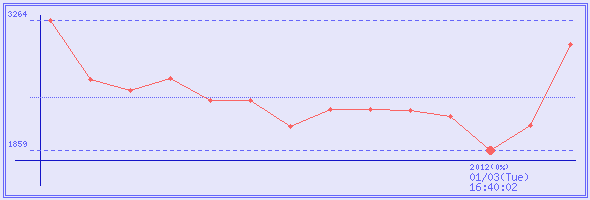
価格の変動(直近3回 : ¥0は未調査回)
取得日時
販売価格
ポイント
実質価格
在庫状態
2015/08/02 (Sun) 06:52:07
¥3,000
0 %
¥3,000
1点在庫あり。(入荷予定あり)
2012/12/01 (Sat) 15:42:51
¥2,127
0 %
¥2,127
2012/01/03 (Tue) 16:40:02
¥1,859
0 %
¥1,859
サイト内キーワード検索
商品名の検索は通常の商品検索ボックスで。
コメントやスペックなどから検索したい場合はこちらから。
コメントやスペックなどから検索したい場合はこちらから。











広告